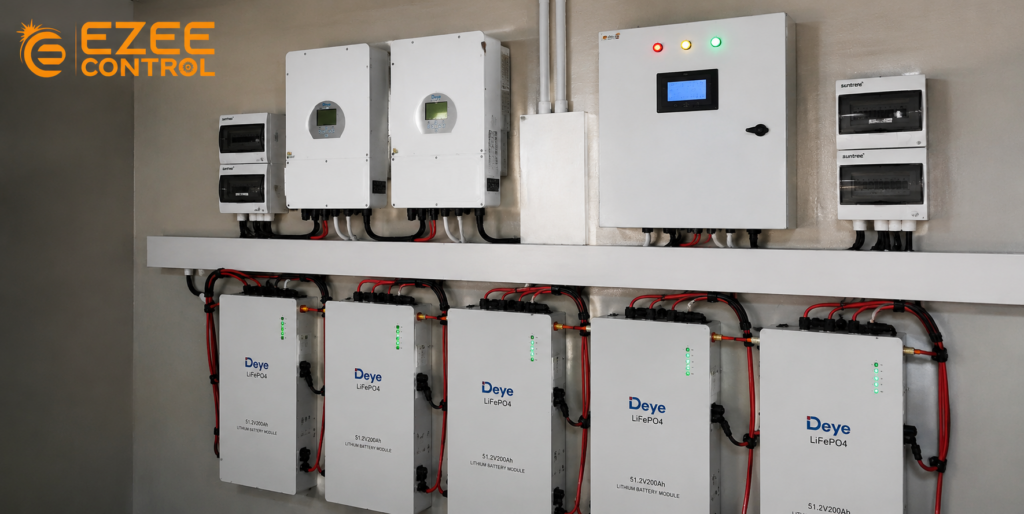
ESS stands for Energy Storage System. In the context of solar, it refers to a battery bank and the associated management electronics that store electrical energy for later use. The stored energy can come from three sources: solar panels during the day, the GEPCO grid during off-peak hours, or a combination of both.
During a load shedding event, the ESS inverter disconnects from the grid automatically and powers your selected loads from the battery bank. When grid power returns, the system reconnects and resumes normal operation. The switchover happens in milliseconds. You do not need to do anything.
An ESS is different from a full hybrid solar system. A hybrid system includes solar panels, a hybrid inverter and a battery bank installed together as a complete unit from the start. An ESS can be added to an existing solar installation that already has panels and an inverter, by upgrading the inverter and adding a battery bank. It can also be installed without solar panels as a standalone battery backup system charged from the grid.
Key distinction: ESS is battery storage. It can retrofit onto an existing on-grid system. A hybrid system is a complete new installation. Both provide load shedding backup — the right choice depends on what you already have.
Two Ways to Use an ESS
Use Case 01
Adding Battery Backup to an Existing On-Grid System
If you already have an on-grid solar system and want to add load shedding backup, an ESS retrofit is the most direct path. Your existing panels remain in place. The change involves replacing your grid-tied inverter with a hybrid inverter capable of managing battery charging and discharging, then connecting a LiFePO4 battery bank.
If your existing system uses a Solis S5 grid-tied inverter, it must be replaced with a Solis S6 hybrid inverter to support battery integration. The Solis S5 is a grid-tied inverter only and cannot manage a battery bank. The panels, mounting and wiring typically remain unchanged. The result is a system with solar generation, battery backup and grid connection — functionally equivalent to a hybrid system installed from scratch.
This is the most common ESS enquiry we receive: customers who installed on-grid solar one or two years ago and now want to add battery backup as load shedding has increased in their area.
Use Case 02
New ESS Installation Without Existing Solar
An ESS can also be installed without any solar panels as a standalone grid-charged battery backup system. The battery charges from GEPCO supply during available hours and discharges during load shedding. There is no solar generation in this configuration — the battery is the only energy source during outages.
This is suited to properties where roof space or budget prevents a full solar installation but where load shedding backup is the primary requirement. It is also used as a bridging solution before a full solar system is installed. Under the NEPRA Prosumer Regulations 2026 net billing framework, a grid-charged ESS without solar panels does not qualify for net billing but it does provide reliable backup power.
ESS Add-On vs Full Hybrid System
If you are deciding between retrofitting your existing on-grid system with ESS or replacing it with a full hybrid system, the table below covers the key considerations.
Consideration
ESS Add-On
Full Hybrid System
You already have on-grid solar
Ideal — retrofit only
Requires full new system
You are installing from scratch
Possible but hybrid is more cost-effective
Most cost-effective option
Upfront cost
Lower — battery and inverter change only
Higher — panels, inverter, battery all new
Inverter replacement needed
Yes — Solis S5 must be replaced with Solis S6
N/A — hybrid inverter included
Bill reduction
From existing on-grid panels (already happening)
From new hybrid system
Load shedding backup
Yes — from ESS battery bank
Yes — from hybrid battery bank
Self-consumption optimisation
Yes — charges from solar first
Yes — more efficiently integrated
Net billing eligible
Yes — existing on-grid approval remains
Yes — with GEPCO net billing application
For most customers with existing on-grid systems, ESS retrofit is the right choice. You have already paid for the panels. Adding an inverter upgrade and a battery bank gets you backup power at a lower total cost than replacing the whole system. For customers installing from scratch with backup as a priority, a hybrid solar system is more cost-effective than a separate on-grid solar system plus ESS.
How We Size an ESS for Your Property
ESS sizing starts from your backup load list and the number of hours of backup you need. Unlike a full solar system where we review your electricity bill, ESS sizing begins with the loads you want to keep running during a load shedding event specifically.
Identify Backup Loads
List the appliances you want to run during load shedding. Common backup loads for residential properties include lighting, ceiling fans, a refrigerator, a router and phone chargers. Add an air conditioner if required. Each item has a rated wattage. We add them up to get your total backup load in kilowatts.
01
Determine Backup Duration
How many hours of backup do you need per load shedding event? Average load shedding in most parts of Punjab is 4 to 8 hours. Some areas experience 10 or more hours. The battery must store enough energy to run your backup loads for your target duration.
02
Calculate Required Capacity
Total backup load in kW multiplied by backup hours gives the required energy in kilowatt-hours. A 2kW backup load running for 6 hours requires 12kWh of usable battery capacity. Because LiFePO4 batteries are typically discharged to 80 to 90 percent of their rated capacity, the required nominal capacity is slightly higher. We calculate the exact figure and recommend the number of battery units needed.
03
Backup Load Configuration
Backup Hours Needed & Nominal Capacity Matrix
1kW (fans, lights, router)
6 hours allocation profile
2kW (above plus refrigerator)
6 hours allocation profile
3kW (above plus small AC)
4 hours allocation profile
5kW (above plus additional loads)
6 hours allocation profile
These are indicative figures. Actual capacity depends on your specific appliance ratings, inverter efficiency and depth of discharge settings. We confirm the exact specification at the free assessment visit.
LiFePO4 Battery Brands We Install for ESS
We supply and install four LiFePO4 battery brands for ESS projects. LiFePO4 chemistry only. We do not install lead acid or standard lithium batteries for ESS applications. LiFePO4 handles repeated deep cycling and Pakistan's ambient temperature range more reliably than older chemistries.
Pylontech Fidus
Capacity: 5.12kWh | LiFePO4
Pylontech is one of the most widely used ESS battery brands in Pakistan. The Fidus unit is a 5.12kWh rack-mounted module. Multiple units connect in parallel to build the required capacity. Compatible with Solis S6 hybrid inverters. Built-in battery management system monitors temperature, voltage and state of charge. Manufacturer warranty documentation handed over at installation.
Dyness DL 5.0
Capacity: 5.12kWh | LiFePO4
Dyness DL 5.0 is a 5.12kWh wall-mounted LiFePO4 battery unit. Used in our completed off-grid installation at Jamia Masjid Mumtaz Shaukat in Jalil Town. Dyness units are compact and suited to properties where rack mounting is not practical. Multiple units connect in parallel. Dyness has been in the Pakistan market long enough to have a local support and parts chain.
Sunwoda LiFePO4 ESS
Capacity: ~5kWh Units | LiFePO4
Sunwoda is an established LiFePO4 battery manufacturer. Sunwoda ESS units are suited to residential and small commercial ESS applications. Compatible with standard hybrid inverter communication protocols. Available where Pylontech and Dyness stock is constrained or where a customer-specified alternative is requested. Manufacturer warranty documentation handed over at installation.
Luminey LiFePO4 ESS
Capacity: ~5kWh Units | LiFePO4
Luminey LiFePO4 units are available as an alternative for ESS installations. Suited to residential backup applications. Specified where the customer requests a Luminey unit or where it offers a pricing advantage within the same chemistry and capacity range. Manufacturer warranty documentation handed over at installation.
To learn more about standalone battery prices and mechanical configurations, check our catalog on solar battery options and pricing.
How An ESS Charges and Discharges
The charging and discharging priority of an ESS is set in the hybrid inverter configuration. At Ezee Control we set the following priority order as standard for ESS installations.
Charging Priority
Solar generation charges the battery first when solar is available. This is the highest value energy source because every unit stored from solar saves you the full grid import cost when you draw it later during load shedding. Once the battery is fully charged from solar, any remaining solar generation is used to power running loads or exported to the grid under the net billing framework. If solar generation is insufficient to fully charge the battery by evening, the inverter can be configured to top up from the grid during off-peak hours or at a set threshold.
Discharging Priority
During load shedding, the battery discharges to power your backup loads at the priority you have set. Once the battery reaches its minimum discharge threshold — typically 10 to 20 percent of rated capacity for LiFePO4 — the inverter stops drawing from it to protect battery life. When grid power returns, the battery begins recharging from solar or grid according to the priority setting.
Self-Consumption Optimisation Under Net Billing
Under the NEPRA Prosumer Regulations 2026, exported solar units earn approximately PKR 11 per unit while grid imports cost PKR 40 to 50 or more. An ESS configured to maximise self-consumption stores surplus solar generation during the day instead of exporting it. That stored energy is used at night or during load shedding, saving the full import tariff instead of earning only the lower export rate. This configuration delivers a stronger financial return under net billing than a system that exports surplus freely.
ESS Energy Storage System Questions
Can I add an ESS to my existing on-grid solar system?
Yes. If your existing system uses a Solis S5 grid-tied inverter, we replace it with a Solis S6 hybrid inverter and connect a LiFePO4 battery bank. Your panels, mounting structure and wiring remain in place. The result is a fully functional backup system without replacing the entire installation.
Does adding an ESS affect my existing GEPCO net billing approval?
Adding a battery to an existing approved on-grid system does not automatically invalidate your net billing approval. However, any changes to the system that materially alter its configuration may require notification to GEPCO. We advise on the correct process at the assessment stage based on your existing approval status.
How many battery units do I need for 6 hours of backup?
It depends on your backup load. A typical home backup load of 2kW running for 6 hours requires approximately 12kWh of usable battery capacity — about 2 to 3 Pylontech Fidus or Dyness DL 5.0 units of 5.12kWh each. An air conditioner in the backup load increases this significantly. We calculate the exact number from your appliance list.
What is the difference between Pylontech, Dyness, Sunwoda and Luminey batteries?
All four are LiFePO4 chemistry and perform reliably in Pakistan conditions. Pylontech Fidus is rack-mounted and widely used in the market. Dyness DL 5.0 is wall-mounted and compact. Sunwoda and Luminey are available as alternatives where the other brands are constrained or a customer requests them specifically. Capacity per unit is similar across all four at around 5kWh. Brand recommendation depends on availability, inverter compatibility and your budget.
Can an ESS charge from the grid when there is no solar?
Yes. The hybrid inverter can be configured to charge the battery from the GEPCO grid during available hours. This is useful for properties without solar panels using ESS as a standalone backup system. For properties with solar panels, we set charging priority to solar first and grid top-up only when solar is insufficient to reach the target charge level.
How long does an ESS installation take?
A retrofit ESS installation on an existing on-grid system typically takes 1 to 2 days — inverter replacement plus battery bank wiring and commissioning. A new ESS installation without existing solar takes 1 day for small battery banks. Larger installations with 4 or more battery units may take 2 days. The written proposal includes a specific timeline.
Is ESS the same as a UPS?
No. A conventional UPS uses sealed lead acid batteries and is designed for short outages of minutes to a few hours. An ESS uses LiFePO4 batteries, supports much larger capacities, handles many more charge cycles over its life and is designed for daily deep cycling over years. An ESS is also more efficient and compatible with solar charging, which a conventional UPS is not.
Tell Us Your Backup Load and We Will Size the Right ESS
Send us your appliance list and the hours of backup you need on WhatsApp. We will tell you how many battery units are required and which brand fits your inverter and budget. Free assessment. Written proposal with fixed price before any work starts.