Home > Services > On-Grid Solar System

On-Grid Solar System Installation

Lowest upfront cost. Maximum bill reduction. Designed for self-consumption under NEPRA Prosumer Regulations 2026.
No battery required — lowest cost solar solution available
Surplus generation credited under GEPCO net billing
Solis S5 inverter — LONGi Hi-MO X6 panels
System sized for your daytime consumption, not just your total monthly bill
Free site survey and written fixed-price proposal before work begins
On-grid solar system installation by Ezee Control in Pakistan

What Is an On-Grid Solar System

An on-grid solar system connects directly to the utility grid. It has three main components: solar panels, a grid-tied inverter and the existing grid connection. There are no batteries.

During daylight hours, the panels generate DC electricity. The inverter converts it to AC at the same frequency and voltage as your GEPCO supply. This power flows into your property first and covers your running loads. If generation exceeds what your property is consuming at that moment, the surplus flows back into the GEPCO grid. Under the NEPRA Prosumer Regulations 2026, GEPCO purchases that surplus at the national average energy purchase price of approximately PKR 11 per unit and credits it to your electricity account.

When the sun sets or generation drops below consumption, the inverter draws the shortfall from the grid automatically. There is no switch to flip. The system manages the transition between solar and grid supply without any input from you.

Critical note: An on-grid system shuts down during load shedding. It requires a live grid connection to operate safely. If your priority is backup power during outages, you need a, hybrid solar system or an ESS unit added to this system.

Net Billing Under NEPRA Prosumer Regulations 2026

On February 9, 2026, NEPRA notified the Distributed Generation and Net Billing Regulations 2026, replacing the old net metering framework. This change affects every new solar connection in Pakistan. If you are considering an on-grid system, understanding this regulation is essential before you make a decision about system size.

What Changed

Under the old net metering rules, one unit you exported to the grid cancelled one unit you imported. The math was simple and export was valuable because it offset grid electricity at the full consumer tariff.

Under net billing, the buyback rate for exported units is set at the national average energy purchase price, currently approximately PKR 11 per unit. But you pay the standard consumer tariff when importing from the grid, currently PKR 40 to 50 or more per unit depending on your consumption slab. The gap between what you receive for exports and what you pay for imports is now significant.
Item
Old Net Metering (pre Feb 2026)
Export rate
Unit for unit offset at tariff rate
Approx PKR 11 per unit (national average purchase price)
Import rate
Standard consumer tariff
Standard consumer tariff (PKR 40 to 50 plus per unit)
Export value
High — matches import tariff
Lower — significant gap vs import rate
Best system design
Maximise generation and export
Maximise self-consumption first
Sizing strategy
Oversize for maximum export
Size to match consumption, not to oversize
New connections from
No longer available
February 9 2026 onwards

What This Means for System Sizing

The most important consequence of net billing is that self-consumption is now far more valuable than export. Every unit your solar panels produce that you consume directly saves you the full import tariff rate. Every unit you export earns only approximately PKR 11.

Under the old net metering framework, oversizing a system to maximise export made financial sense. Under net billing, oversizing a system that exports more than it self-consumes delivers a poor return on the additional investment. The right system size under net billing is one that closely matches your actual daytime consumption rather than one designed to maximise export.

Existing Net Metering Contracts

If you already have an approved GEPCO net metering connection from before February 9, 2026, your existing contract remains valid until it expires. You are not forced onto net billing until your contract renewal. New connections and renewals from February 9, 2026 are governed by the net billing framework.

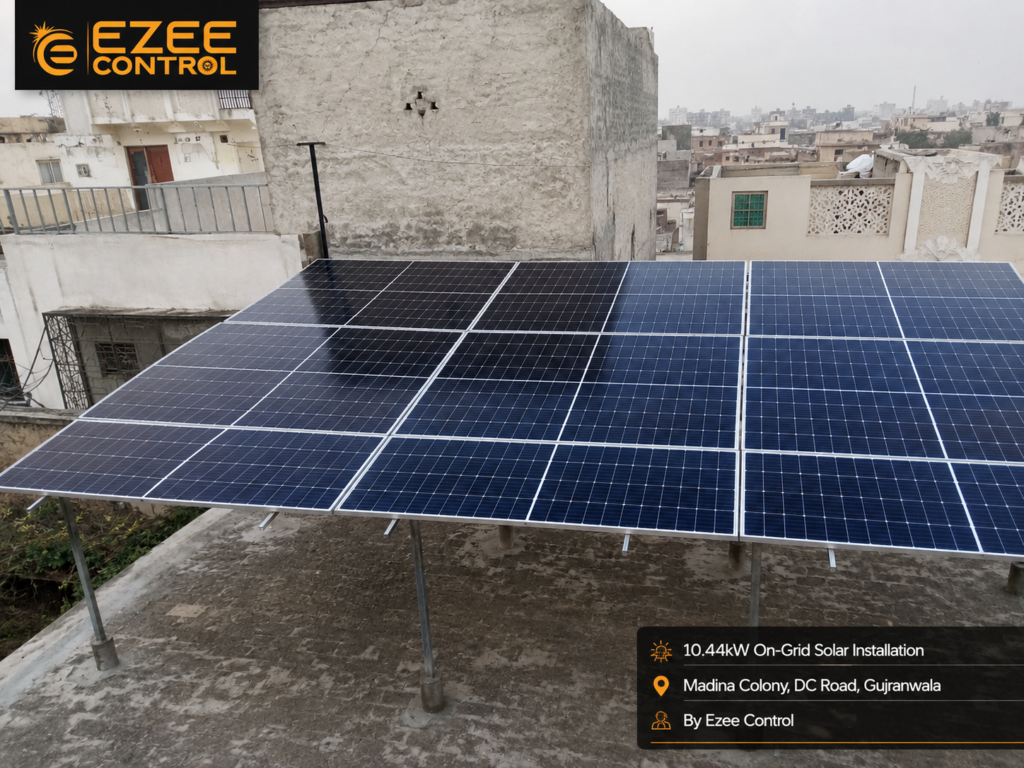
Our Project 1 — Madina Colony

Our 10.44kW on-grid installation in Madina Colony, DC Road, Gujranwala was commissioned in January 2025 and received GEPCO net metering approval before the February 2026 regulation change. That contract remains valid under the old net metering terms until expiry. New on-grid installations from February 2026 are designed under net billing rules with self-consumption as the primary objective. For details on modern layout registration parameters, read our complete step-by-step guide to GEPCO net billing.

Designing for Maximum Self-Consumption Under Net Billing

Under the NEPRA Prosumer Regulations 2026, we design on-grid systems to maximise the percentage of solar generation consumed on-site rather than exported to the grid. This is the most effective way to improve the financial return on an on-grid installation under the current regulatory framework.

Size to Your Daytime Load

We review your electricity bills and identify which appliances run during daylight hours. The system is sized so that solar generation closely matches your daytime consumption pattern. A property that runs heavy loads primarily in the evening will get less financial benefit from on-grid solar than one that runs washing machines, water pumps, refrigerators and air conditioning during the day.

Load Scheduling Advice

We advise customers to shift discretionary loads to daylight hours where possible. Running the washing machine, water pump, iron and other high-consumption appliances between 9am and 4pm means those units come from solar at zero marginal cost rather than from the grid at PKR 40 to 50 per unit. Over the life of a system, this habit significantly improves the effective return.

Avoid Oversizing for Export

A common mistake is installing a much larger system than daytime consumption justifies on the assumption that export will pay for the extra panels. Under net billing at PKR 11 per unit, the payback period on additional panels beyond self-consumption needs is considerably longer than on the core system. We flag this during the proposal stage and recommend sizing that delivers the strongest financial return rather than the highest generation figure.

Equipment We Install for On-Grid Systems

On-Grid Inverter — Solis S5 Series

The Solis S5 is our primary grid-tied inverter for on-grid installations. It is a string inverter designed for grid export and self-consumption without battery integration. Available in sizes from 3kW to 20kW single phase. The S5 includes WiFi monitoring via the SolisCloud app, real-time export and consumption tracking, and NEPRA-compatible grid protection settings. Our on-grid installation in Madina Colony used the Solis S5, which received GEPCO net billing approval under the pre-2026 framework. Complete dynamic properties can be cross-referenced at the Solis S5 inverter specifications panel.

Solar Panels — LONGi Hi-MO X6 and X10

LONGi Hi-MO X6 580W Mono PERC panels are our standard stock for on-grid systems. The Hi-MO X10 645W is available for projects requiring higher output per panel or with limited roof space. LONGi is a globally recognised Tier-1 solar panel manufacturer. All manufacturer warranty cards and datasheets are handed over at project completion. Detailed architectural cell mechanics are available via the LONGi Hi-MO X6 580W hardware profile.

Protection and Balance of System

Every on-grid installation includes DC surge protection devices, DC and AC isolators, AC MCBs and earthing. Anti-islanding protection is standard on the Solis S5, which is required for GEPCO grid connection approval. WiFi monitoring is configured before handover.

What Size On-Grid System Do You Need

System size should match your daytime consumption, not your total monthly consumption. A property that consumes 600 units per month but runs most loads at night is a poor candidate for a large on-grid system under net billing. A property that consumes 600 units primarily during the day is an excellent candidate.
Monthly GEPCO Bill
Typical On-Grid System Size
PKR 8,000 to 15,000
3kW on-grid. Covers daytime base load.
PKR 15,000 to 25,000
5kW on-grid. Covers daytime load including one AC.
PKR 25,000 to 45,000
8kW to 10kW on-grid. Larger daytime consumption.
PKR 45,000 and above
10kW to 20kW. Site survey mandatory for correct sizing.
Commercial and institutional
3-phase on-grid or hybrid assessed after load review.
These are indicative ranges. Your actual system size is confirmed at the site survey based on your bill history, roof space, shading and daytime consumption pattern.

When an On-Grid System Is the Right Choice for You

On-Grid Works Well When

Your priority is maximum bill reduction at the lowest possible upfront cost. You have predictable daytime loads that can absorb most of the solar generation. Your area has minimal load shedding or you have an existing backup solution. You are a business, school or mosque with heavy daytime operations where most consumption happens during solar generation hours.

On-Grid Has Limitations When

Your area has regular load shedding and you need backup power. An on-grid system shuts down when the grid goes down. If load shedding is a real operational problem for your household or business, a hybrid system or an ESS unit is the more practical investment. The marginal cost of adding battery backup at the time of installation is lower than retrofitting it later.

On-Grid Plus ESS Later

If budget is the primary constraint today, an on-grid system can be installed now and an ESS unit added later when budget allows. The Solis S5 inverter is not natively hybrid-compatible, so adding battery backup later means replacing the inverter with a Solis S6 hybrid unit in addition to the battery. This is worth factoring into the upfront decision.

On-Grid Solar System Questions

Does an on-grid system work during load shedding?

No. An on-grid system requires a live grid connection to operate. When GEPCO cuts power, the inverter shuts down within milliseconds as a safety requirement. This prevents back-feeding the grid while workers may be repairing lines. If you need power during load shedding, you need a hybrid system with batteries or an ESS unit.

What is the difference between net metering and net billing in Pakistan?

Net metering, available before February 9 2026, allowed you to offset grid imports unit for unit with solar exports at the full consumer tariff rate. Net billing, introduced under NEPRA Prosumer Regulations 2026, pays approximately PKR 11 per unit for exports while you pay PKR 40 to 50 or more per unit for grid imports. Self-consumption is now far more financially valuable than export.

What size on-grid system should I install under net billing rules?

Under NEPRA Prosumer Regulations 2026, size your system to match your daytime consumption rather than your total monthly consumption. Exporting surplus units earns only approximately PKR 11 per unit. Every unit consumed directly from solar saves you the full import tariff. Oversizing beyond your daytime load delivers a poor return on the extra panels.

How long does an on-grid installation take?

A residential on-grid installation up to 10kW typically takes 2 to 3 days. Larger commercial systems may take 3 to 5 days. The timeline includes mounting structure installation, panel fitting, inverter wiring, protection setup, commissioning and monitoring app configuration.

Can I monitor my on-grid system remotely?

Yes. Every Solis S5 inverter includes WiFi monitoring through the SolisCloud app. You can view real-time solar generation, grid import and export figures, and historical production data from your phone. The app is set up on your phone before our team leaves on the commissioning day.

Can I upgrade an on-grid system to hybrid later?

You can add battery backup later, but it requires replacing the Solis S5 grid-tied inverter with a Solis S6 hybrid inverter in addition to purchasing the battery units. The panels and mounting structure remain. If there is any possibility you will want battery backup within the next few years, the hybrid option at installation time is more cost-effective than retrofitting later.

Completed On-Grid Installation

10.44kW On-Grid | Madina Colony, DC Road, Gujranwala | January 2025

This residential property in Madina Colony, DC Road was paying PKR 45,000 per month on GEPCO bills. The roof required a customised elevated mounting structure due to the angle and shading conditions. We installed the Solis S5 on-grid inverter with LONGi Hi-MO X6 580W Mono PERC panels. After commissioning and GEPCO net metering approval under the pre-February 2026 framework, the monthly bill reduced to nil with surplus units credited to the account.
This project was completed under the old net metering framework and its contract remains valid until expiry. New on-grid projects from February 2026 are designed and documented under the NEPRA Prosumer Regulations 2026 net billing framework. see all completed projects.

Send Us Your Appliance List

For an off-grid system, the most useful thing you can send us is your appliance list: what runs on the system and for how many hours per day. WhatsApp this to us along with your property type and location and we will give you an indicative system size before the site survey. No charge. No obligation.
© 2026 Ezee Control Private Limited. All rights reserved. Registered with SECP & FBR.
Headquarters: Citi Housing Society, Gujranwala, Punjab, Pakistan.
Call Expert:
+92 339 6000105
WhatsApp Blueprint:
+92 339 6000105