Home > Services > Off-Grid Solar System

Off-Grid Solar System Installation

No WAPDA connection needed. Panels and batteries cover your full daily load around the clock.
Complete energy independence — no electricity bill, no grid dependency
Suited to mosques, farms, tube wells and remote properties
GoodWe inverter — Dyness DL 5.0 LiFePO4 battery — LONGi panels
Battery sized from real load inventory, not a generic estimate
Free site survey and written fixed-price proposal before work begins
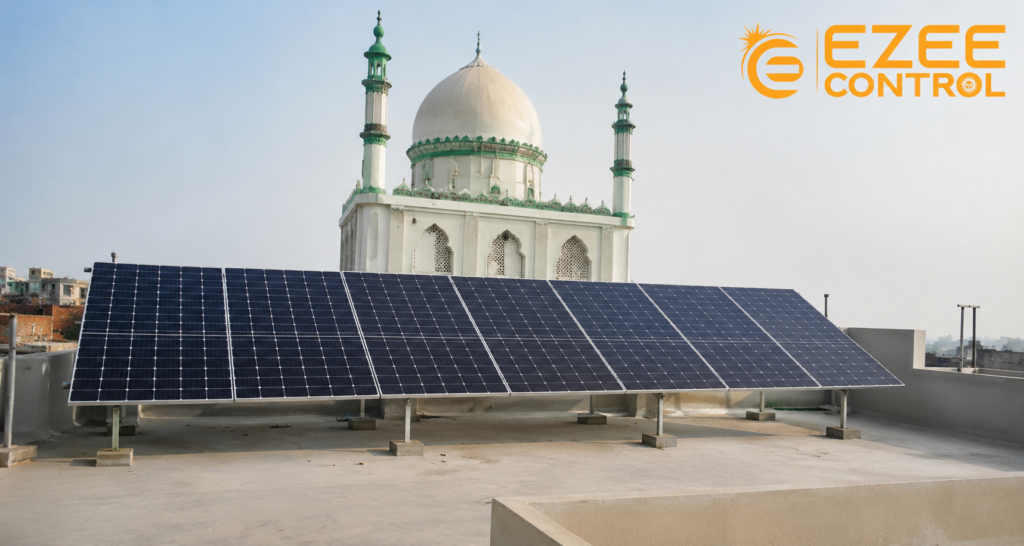
Hybrid solar system installation by Ezee Control showing LONGi panels and Solis S6 inverter

What Is an Off-Grid Solar System

An off-grid solar system has no connection to the utility grid. It consists of three components: solar panels, a charge controller or hybrid inverter, and a battery bank. The panels generate DC power during daylight hours. The inverter manages charging the battery and converting power to AC for your loads. The battery stores energy for use after sunset or during cloudy periods.

Because there is no grid connection, the system must be sized to cover the full daily energy requirement from solar generation alone. This is the critical difference between off-grid and hybrid design. A hybrid system can draw from the grid when solar or battery falls short. An off-grid system cannot. Every unit of energy the property needs must come from the panels and the battery bank.

This makes battery sizing the most important decision in an off-grid project. Undersize the battery and the property runs out of power before morning. Oversize it and you pay for capacity you never use. We calculate battery size from your actual daily load list, not from a generic rule of thumb.

Key distinction: Off-grid systems have no grid connection and no electricity bill. Hybrid systems have both solar and grid. If you have grid access and want bill reduction plus backup, hybrid solar system is the right choice.

Who Needs an Off-Grid Solar System

Off-grid is not for every property. It is specifically suited to situations where the grid is absent, unreliable or economically irrational to connect to. Here are the five property types where off-grid solar makes the most sense.

Mosques in Low-Grid or Rural Areas

A mosque that runs primarily during prayer times has a specific and predictable load profile: lighting, fans, a water pump and possibly an air conditioning unit during summer. When grid supply in the area is unreliable or the connection cost is high relative to consumption, an off-grid system eliminates both the bill and the supply uncertainty. Our completed project at Jamia Masjid Mumtaz Shaukat in Jalil Town reduced the monthly GEPCO bill from PKR 35,000 to nil through an off-grid configuration.

Agricultural Tube Wells

Tube well motors typically run at 5kW to 15kW or more. Running a tube well on WAPDA power during agricultural seasons when electricity is most expensive or load shedding is at its worst is a serious operational problem. An off-grid solar system sized for the motor load and daily run hours eliminates diesel generator costs and grid dependency entirely. Battery bank or direct solar-to-motor configurations are both viable depending on the run schedule.

Remote Farms and Agricultural Properties

Farms located outside the WAPDA service area or where the cost of extending a grid connection exceeds several years of electricity savings are ideal candidates for off-grid solar. Lighting, water pumps, grain storage cooling, security cameras and worker accommodation loads can all be covered by a properly sized off-grid system.

Properties With Extremely Unreliable Grid Supply

Some areas in Punjab and Sindh experience 16 to 20 hours of load shedding per day during summer. In these situations, a hybrid system provides partial cover but the battery bank is constantly depleted and cannot recover fully before the next outage. An off-grid configuration decouples the property entirely from the grid schedule and runs on solar and battery regardless of what WAPDA does.

Construction Sites and Temporary Facilities

Sites under construction that need power before a grid connection is established, or temporary facilities such as event spaces, remote camps and field offices, benefit from portable or semi-permanent off-grid solar setups. No connection application, no waiting, no monthly bill.

How We Size an Off-Grid Solar System

Off-grid sizing begins with the load list, not the electricity bill. There is no bill for most off-grid sites. We calculate the system size from the ground up using the following steps.

Complete Load Inventory

We list every electrical appliance or device that will run on the system. For each item we note the rated wattage and the number of hours it runs per day. A 60W LED tube light running 6 hours uses 360 watt-hours per day. A 1.5-ton air conditioner running 8 hours uses approximately 9,600 watt-hours per day. We add up every item to get the total daily energy requirement in watt-hours or kilowatt-hours.
01

Battery Bank Sizing

The battery bank must store enough energy to cover the night load plus a safety buffer for cloudy days. We design for a minimum of 1 to 1.5 days of autonomy for most properties, meaning the system can run for a full day and night without any solar input before the battery drops to its minimum threshold. For critical loads such as medical facilities or water pumps, we may extend this to 2 days. Dyness DL 5.0 LiFePO4 5.12kWh units can be connected in parallel to reach the required capacity.
02

Solar Panel Array Sizing

The panel array must generate enough energy each day to cover the daily load and recharge the battery from its overnight discharge. We calculate this based on the average peak sun hours for the installation location, typically 4.5 to 5.5 hours per day in Punjab, and a system performance ratio that accounts for temperature losses, wiring losses and inverter efficiency. The result is the minimum panel capacity required.
03

Inverter Selection

The inverter must handle the peak simultaneous load of all appliances that run at the same time. A property with a 1.5-ton AC, a water pump and lighting running simultaneously needs an inverter rated above the combined peak wattage. For single phase off-grid systems we use the GoodWe single phase hybrid inverter, which is specifically suited to battery-first off-grid operation. For properties with large motor loads such as tube wells, we assess whether a direct solar-to-motor drive or a full inverter system is more appropriate.
04
Daily Load (kWh)
Approximate Panel Size
Up to 5 kWh
3kW to 5kW panels
5 to 10 kWh
5kW to 8kW panels
10 to 20 kWh
8kW to 15kW panels
Above 20 kWh
Custom engineering assessment required
These are indicative ranges only. Every off-grid system is sized from a real load inventory and site assessment, not from a table. Send us your appliance list and daily run hours on WhatsApp and we will provide an indicative size before the site survey.

Equipment We Install for Off-Grid Systems

Every off-grid system we install uses the same core equipment brands we stock and test. We do not swap brands after quoting.

Off-Grid Inverter — GoodWe Single Phase Hybrid

For single phase off-grid installations, we use the GoodWe single phase hybrid inverter. GoodWe inverters support battery-first operation mode, which prioritises battery charging from solar before any other function. They include anti-islanding protection, charge controller integration and remote monitoring. Our completed off-grid installation at Jamia Masjid Mumtaz Shaukat in Jalil Town used the GoodWe 8kW single phase hybrid inverter, which fully powers the mosque from solar and battery without any grid connection.

Batteries — Dyness DL 5.0 LiFePO4

The Dyness DL 5.0 is a 5.12kWh LiFePO4 lithium iron phosphate battery unit. Multiple Dyness units can be connected in parallel to build the battery bank capacity required for the daily load and autonomy target. LiFePO4 chemistry handles the temperature cycling of Pakistan's climate reliably and supports more charge and discharge cycles than older lithium chemistries. The Dyness DL 5.0 was used in our Jalil Town mosque project and is our primary off-grid battery unit. Learn more about our comprehensive solar battery options and pricing.

Solar Panels — LONGi Hi-MO X6

LONGi Hi-MO X6 580W Mono PERC panels are used across all our installations including off-grid projects. The same panel brand and model is used regardless of system type, which ensures consistent performance data and supply chain reliability. All manufacturer warranty documentation is handed over at project completion.

Protection and Wiring

Every off-grid installation includes DC surge protection, DC isolators, AC circuit breakers, earthing system and appropriate cable sizing for the battery bank current levels. Battery bank wiring is sized for safe continuous current at the depth of discharge the system is designed for. LOTO safety protocols are followed during installation and battery connection. No live working without isolation.

Completed Off-Grid Installation

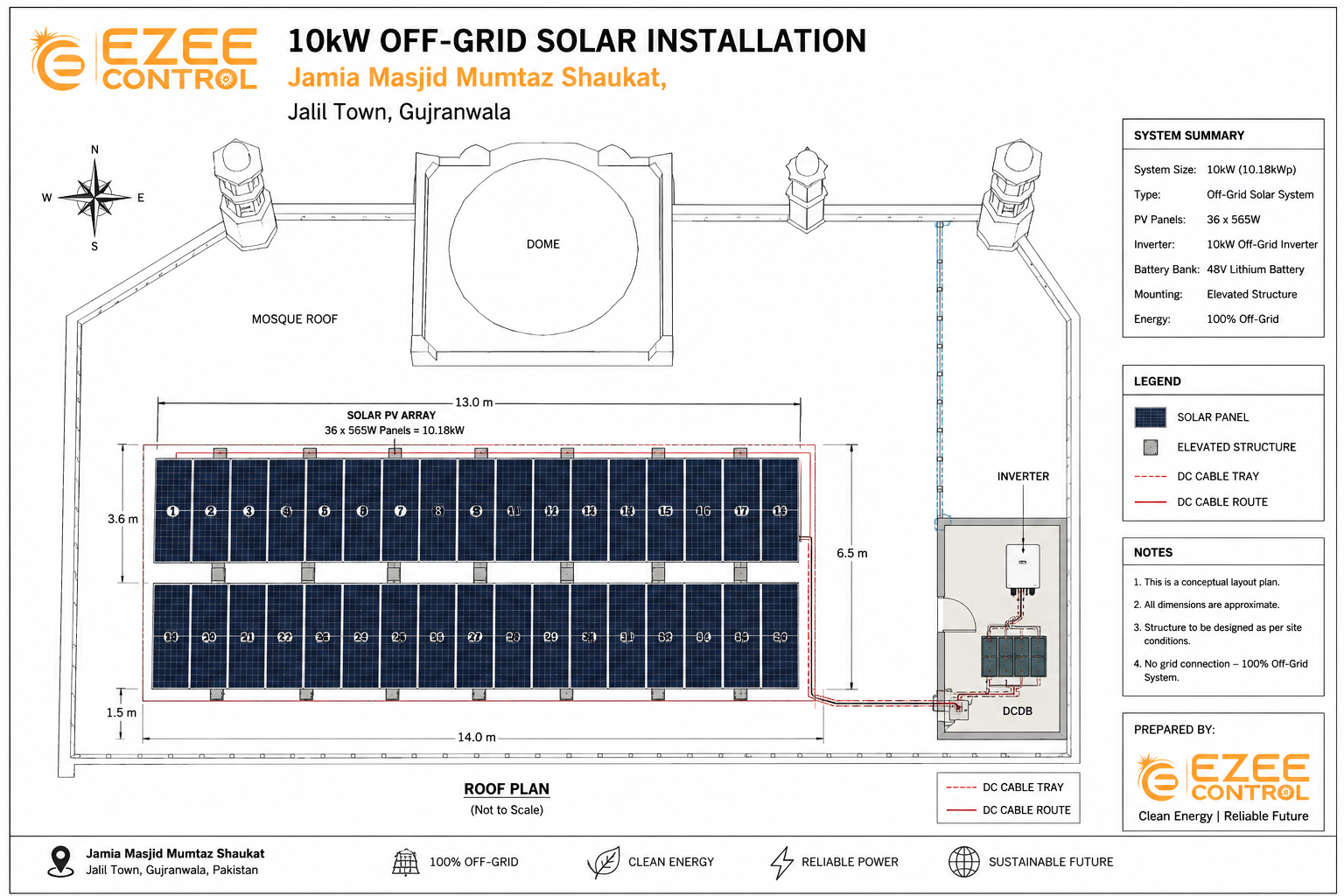
10kW Off-Grid | Jamia Masjid Mumtaz Shaukat, Jalil Town, Gujranwala | May 2025

Jamia Masjid Mumtaz Shaukat in Jalil Town was paying PKR 35,000 per month on GEPCO bills and facing significant load shedding disruption during prayer times. An off-grid configuration was chosen to make the mosque fully independent from the grid, removing both the electricity bill and the impact of outages entirely.

System installed: GoodWe 8kW single phase hybrid inverter operating in off-grid mode, LONGi Hi-MO X6 Mono PERC panels with customised elevated mounting structure, Dyness DL 5.0 LiFePO4 5.12kWh battery bank. Net billing application was not required because the system operates fully off-grid.

After commissioning: Monthly GEPCO bill reduced from PKR 35,000 to nil. The mosque now operates entirely on solar and battery power. Load shedding has no effect on mosque operations.

see full project specifications to review exact engineering criteria.

10kW off-grid solar installation at Jamia Masjid Mumtaz Shaukat Jalil Town Gujranwala by Ezee Control

Off-Grid or Hybrid: Which System Do You Need

The most common question we receive from mosque committees and farm owners is whether to go off-grid or hybrid. The answer depends on two factors: whether you have reliable grid access and what you want to achieve.
Situation
Recommended System
No grid connection at all
Off-grid. Only viable option.
Grid exists but load shedding is 16 or more hours per day
Off-grid. Hybrid would rely on a grid that is rarely available.
Grid exists and load shedding is 4 to 10 hours per day
Hybrid. Grid supplements battery during extended cloudy periods.
Grid exists and you want bill reduction plus backup
Hybrid. More cost-effective when grid is reliably available.
Property is a tube well with no grid and a single motor load
Off-grid with direct solar-to-motor or battery system as required.
Mosque in an area with moderate load shedding
Either, depending on budget. Off-grid has higher upfront cost.
Off-grid systems have a higher upfront cost than hybrid systems of similar panel capacity because the battery bank must be sized to cover the full daily load without any grid fallback. If grid access exists and load shedding is manageable, a hybrid system is usually the more cost-effective solution. We give you an honest assessment of which system is right for your situation during the site survey.

Off-Grid Solar System Questions

Can an off-grid system run an air conditioner?

Yes, but the battery bank and panel array must be sized specifically for the AC load. A 1.5-ton inverter AC draws approximately 1 to 1.5kW depending on conditions. Running it for 8 hours requires 8 to 12kWh of generation and storage capacity. We calculate the correct battery and panel size from your actual AC specifications and run hours during the site survey.

How many days can an off-grid system run without sunlight?

It depends on the battery bank capacity and the daily load. We typically design off-grid systems for 1 to 1.5 days of autonomy, meaning the battery can power the property for a full day and night without any solar input before reaching its minimum threshold. For critical facilities we extend this to 2 days. Extended cloudy periods beyond this require either a larger battery bank or a backup generator as a supplement.

What happens to an off-grid system at night when the battery is depleted?

When the battery reaches its minimum depth of discharge, the inverter stops drawing from it and cuts power to the loads. A properly sized system should not reach this point under normal conditions. If it does, it indicates the battery bank is undersized for the actual load, the load has increased beyond the design specification, or there has been an extended period of low solar generation. We review this during commissioning and adjust battery management settings accordingly.

Can I add a generator as a backup to an off-grid system?

Yes. A generator can be connected to the inverter as a supplementary charging source for extended cloudy periods or emergency situations. The GoodWe inverter supports generator input. The generator runs only when the battery reaches a low threshold, which means it runs rarely rather than continuously. This reduces diesel costs significantly compared to running a generator as the primary power source.

Does an off-grid system require GEPCO approval or AEDB registration?

No. Off-grid systems have no connection to the GEPCO grid and do not require any DISCO approval, AEDB licence or net billing application. The system is entirely on private property and operates independently. This makes off-grid the simplest system type from a regulatory standpoint.

How long does an off-grid installation take?

A single phase off-grid system for a mosque or small property typically takes 3 to 5 days depending on battery bank size and roof conditions. Larger systems with multiple battery units or complex mounting requirements may take longer. The written proposal includes a timeline specific to your project.

Send Us Your Appliance List

For an off-grid system, the most useful thing you can send us is your appliance list: what runs on the system and for how many hours per day. WhatsApp this to us along with your property type and location and we will give you an indicative system size before the site survey. No charge. No obligation.
© 2026 Ezee Control Private Limited. All rights reserved. Registered with SECP & FBR.
Headquarters: Citi Housing Society, Gujranwala, Punjab, Pakistan.
Call Expert:
+92 339 6000105
WhatsApp Blueprint:
+92 339 6000105